In this article
Private jet travel with children is the one category of booking where the cabin photo tells you almost nothing. A wide aisle and a divan look like they solve the problem of flying with a toddler, and then the operator tells you on the morning of departure that the restraint you brought is not approved for that seat. Every November our desk handles a run of these, because the holiday calendar pushes families onto aircraft they have never flown before, often on short notice. This is the version of the conversation we would rather have in October.
The short version: confirm the seat and the restraint together, before you accept the aircraft, and put every child in the trip brief by age. Our full planning guide on flying with children and infants covers the sequence in detail. What follows is what the desk actually sees go wrong.
Put every child in the trip brief by age
Passenger count is the first thing a charter desk sends to operators, and "four adults, two kids" is not enough information to quote against. Ages matter, because a nine year old and a nine month old create completely different seating problems. An infant needs an approved restraint in a dedicated seat. An older child usually needs a forward facing seat with a working belt, which sounds trivial until you look at a cabin where half the seats face aft or sit around a table.
Tell us how many children, how old, and who needs to sit next to whom. Two parents splitting a cabin so each sits with one child is a different seat map than four adults who do not care where they land. It also changes what happens if the aircraft is substituted. Operators swap tails for maintenance and crew reasons, and a substitution that would be invisible to a business traveler can quietly break a family seating plan. We ask for the arrangement in writing so that a replacement aircraft has to satisfy the same requirement rather than just the same seat count.
Restraints are an operator question, not a cabin feature
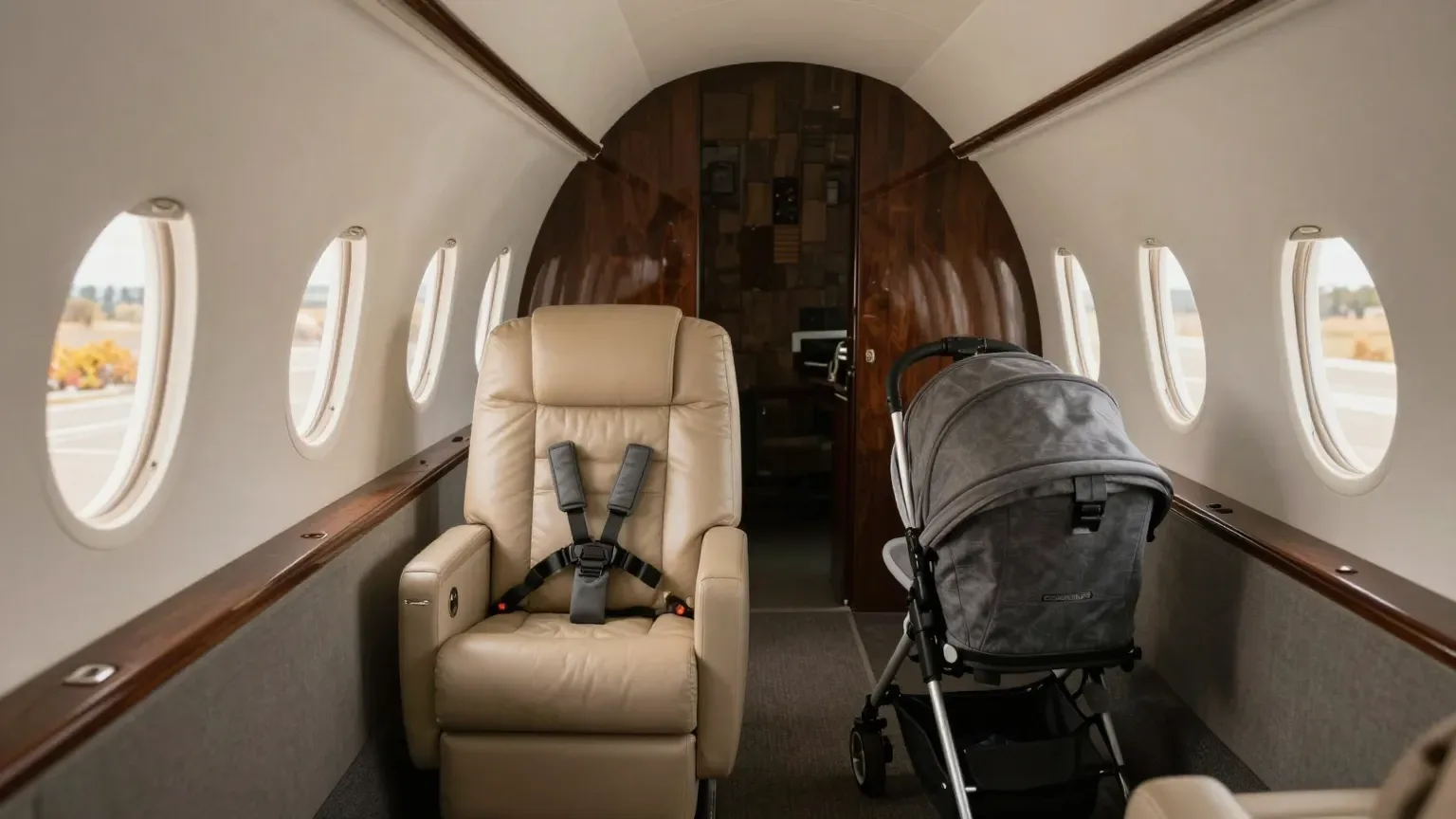
This is the one that catches people. Chartering privately does not remove the need for a child restraint. The FAA recommends that children, including those under two, travel in an approved restraint in their own seat, and the operating carrier decides what is acceptable on their aircraft. A spacious cabin does not establish that a given car seat fits safely on a given seat.
Three things have to line up, and all three are checked with the operator:
- Device approval. The restraint must be approved for aircraft use, which is not the same as being approved for cars. A soft carrier or an ordinary booster is not a substitute.
- Child sizing. The manufacturer sets height and weight limits. Those limits do not relax at altitude.
- Seat compatibility and installation. The device has to physically install on the proposed seat, with that seat's belt geometry, facing the right direction.
Send the operator the restraint make, model and the child's height and weight, and ask for confirmation against the specific tail number. Do the same for bassinets and beds. A cabin that sleeps four does not mean the bed is an approved position for takeoff and landing, and the crew will tell you where the child sits for those phases regardless of what the brochure implies.
Strollers, gear and the baggage math
Families do not travel light, and private jet baggage space is shaped more than it is sized. A stroller that folds flat may still be wrong for a nose compartment with a low door. Give the desk folded dimensions and weight for the stroller, plus a count of anything bulky: pack and play, car seat you plan to check, ski gear if the trip is headed somewhere cold. Our baggage limits guide explains how compartment shape drives these decisions more than total pounds.
Two practical notes from the ramp. First, if you are installing a restraint at the aircraft, build in time for it. Installing a car seat while the crew waits on a slot is nobody's idea of a relaxing start. Second, decide in advance what stays within reach in approved storage during the flight, because the things you want most with a small child (snacks, a change of clothes, the specific stuffed animal) are the things that end up in the nose if nobody asks.
Food is worth a separate sentence. Catering on charter is arranged in advance, not ordered in the air. Tell the desk about allergies, bottle warming, and whether you want anything at all on a short morning leg. Families crossing meal times without saying so is the most common small regret we hear about afterward.
Crossing a border adds a document layer
Holiday trips to Mexico, the Caribbean or Europe bring in paperwork that domestic legs do not. Every child needs their own passport and whatever entry documents the destination requires, and the requirements are set by the destination rather than by a single universal rule. Consent or custody documentation comes up in some circumstances, particularly when one parent is traveling without the other, and it is checked against the specific country rather than against general advice from the internet.
Check the route early. Our international travel guide walks through how customs, crew paperwork and arrival requirements affect timing, and a document problem found three weeks out is an errand while a document problem found at the FBO is a cancelled trip.
What to confirm before you accept the aircraft
If you are booking your first charter with children aboard, run this list before you sign anything. It maps to our first flight guide and to the broader charter checklist.
- Every child is in the passenger count, with ages.
- Restraint approval, sizing and seat compatibility confirmed by the operator for the actual tail.
- The seating arrangement is written down, and a substitute aircraft has to match it.
- Stroller and bulky baggage accepted, with folded dimensions supplied.
- Catering, allergies and comfort items discussed.
- Child travel documents ready for the route.
None of that depends on the size of the aircraft, which is why we would rather you start from the mission than from a category. If you are still deciding what you need, the cost calculator will frame the aircraft question before the family question narrows it further.
The holiday calendar is the constraint
Thanksgiving week and the stretch from the week before Christmas through the first days of January are when the family requests stack up, and they stack up on the same aircraft that everyone else wants. Operators are working peak day rules, crews are working duty limits, and the tail with the seat layout that suits your family is not infinitely available.
The practical move is to brief the trip now, even if the dates are soft. Restraint confirmation and document checks take days of back and forth with the operator, not minutes, and those days are much easier to find in October than in the third week of November. If you are also bringing an animal, our note on flying with pets over the holidays covers that half of the household.
Tell us the route, the dates, and the ages. We will do the rest of the asking.
Questions this raises
Asked at the desk
Chartering privately does not remove the need for a child restraint. The FAA recommends an approved restraint in the child's own seat, including for children under two, and the operating carrier confirms what is acceptable on that aircraft.
Only if it is approved for aircraft use and fits the proposed seat. Send the operator the make, model and the child's height and weight, and ask them to confirm approval, sizing and installation against the specific tail number.
Yes. Every child goes in the passenger count with their age, because seating and restraint planning depends on it. Leaving an infant off the brief is the most common reason a cabin plan falls apart on departure day.
Do not assume so. Use the seating and restraint arrangement the operator approves for takeoff and landing, which may differ from where the child can rest in cruise.
Earlier than you would for an adults-only trip. Restraint confirmation and document checks run days of back and forth with the operator, and Thanksgiving and the winter break compress availability on exactly the aircraft that suit families.
JetNine dispatch desk · Updated October 19, 2026 · how it works · first booking · family travel · seasonal