In this article
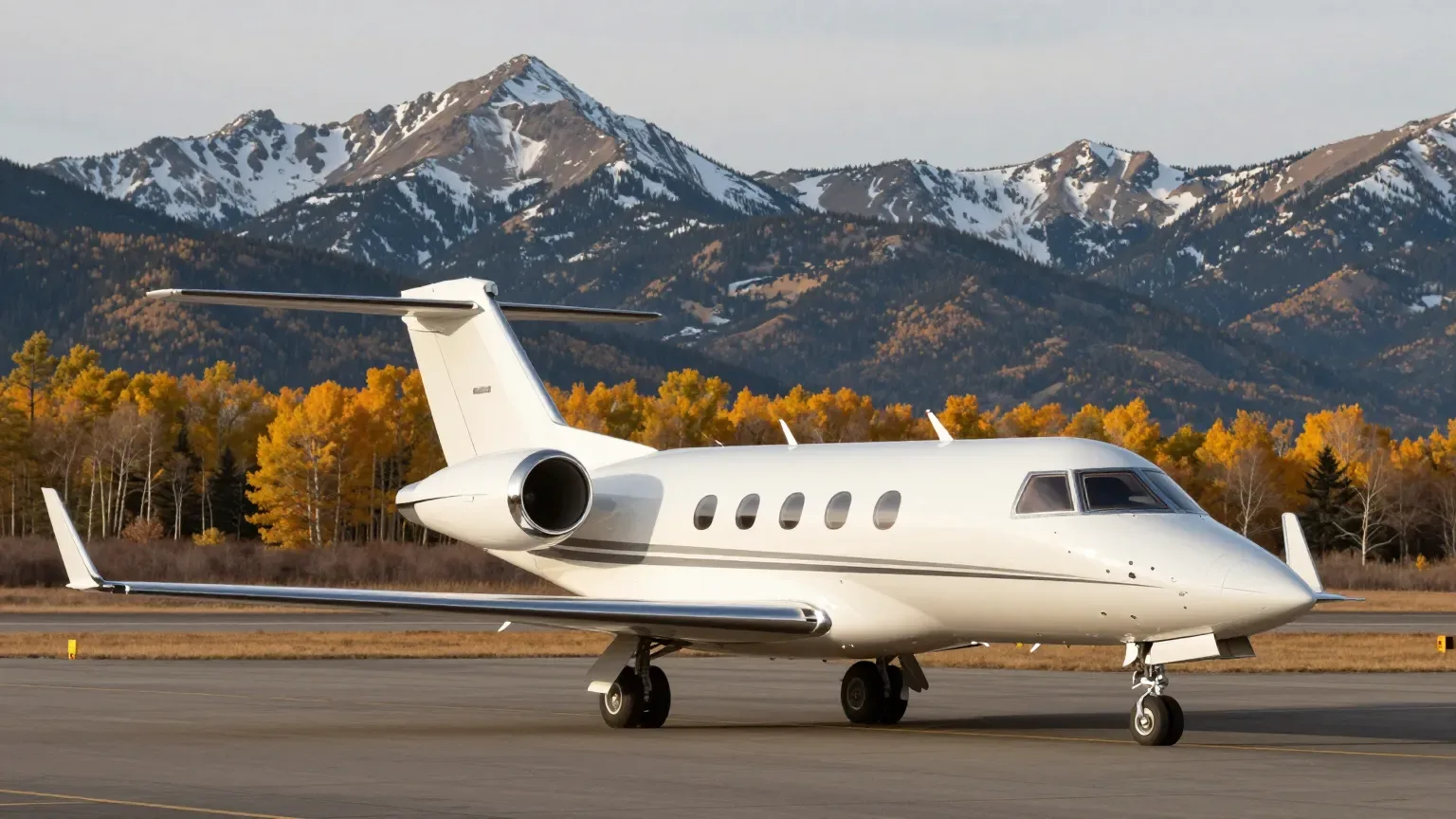
It is the second week of September. The aspens above the valley are just starting to turn, the ramp at Aspen-Pitkin is about as calm as it gets all year, and the desk is already quoting Presidents' Day. That is not early. Booking a private jet to Aspen is less about picking a departure time than about planning around one specific airport, and Aspen-Pitkin (KASE) decides more of your itinerary than almost any other field we dispatch into.
Most city markets give you options. Los Angeles has half a dozen usable fields, New York has three that matter, and the right one is a question of drive time. Aspen has one. Everything else about the trip, the aircraft, the departure hour, the backup plan, follows from that single runway at 7,800 feet.
The airport is the assignment
KASE sits at 7,800 feet of elevation in a box canyon. There is one runway. The approach is effectively one way in and the departure one way out, because the terrain does not offer a second opinion. Add a night curfew and, in peak winter weeks, slot controls, and you have an airport that rewards planning and punishes improvisation.
None of that makes Aspen difficult to fly to. It makes Aspen an airport where the details get settled before anyone leaves the house rather than on the ramp. Our Aspen city guide lays out the field, the lanes and the standard we hold operators to when we quote out of KASE. The short version: mountain-current crews and airframes with real hot-and-high margin, or we do not put the trip in front of you.
Elevation picks your aircraft before you do
Thin air is the constant. At 7,800 feet the air gives an engine and a wing less to work with, so takeoff rolls stretch, climb performance softens, and the tradeoff between fuel and payload gets real in a way it never does at sea level. On a warm afternoon the effect compounds. This is why the aircraft conversation for Aspen starts with performance rather than cabin size, which is the reverse of how most charter conversations go.
From the West Coast the math is friendly. On Los Angeles to Aspen the recommended category for four passengers is a light jet, and turboprops handle the field comfortably too. It is a short leg into a small field, which is precisely the mission those airframes were built for.
From the East Coast it gets more interesting. New York to Aspen is a long leg into a short, high runway, which is a genuine tension. Nonstop in a super-midsize works well, and you can read the category profile on the super-midsize page. Go smaller and you are looking at a fuel stop, which is not a failure, just a decision to make deliberately rather than discover at the ramp. Bigger is not automatically better here either. The largest cabins that can technically make the field are not always the ones that make sense once you load six people, their skis and a full winter fuel plan.
The curfew runs your schedule
Aspen has a night restriction, which means the last usable arrival and departure windows are earlier than most people assume, and they are earlier still in December when daylight is short. That one fact reshapes the day.
Practically, it means we back-time your trip instead of forward-planning it. A Friday departure out of Teterboro after a full day of meetings can put you at the edge of the window with nothing left over for a ground hold, a weather delay or a slow passenger. The desk will tell you that when we quote, not when the crew is watching the clock. Sometimes the honest answer is a Saturday morning departure that gets you there rested, and sometimes it is a nearby field with a drive attached. Both beat a diversion.
The same logic runs in reverse on the way home. If your last day includes a lunch reservation and a two hour drive from the mountain, say so up front, because the departure window is a hard edge and not a suggestion.
Weather, alternates, and the drive you agree to in advance
Aspen closes. Not often, but snow, low ceilings and mountain approach minima combine a few times each winter to make the field unusable for a stretch. The standard alternates are Rifle and Eagle, both under an hour's drive with ground that can be arranged in advance.
The thing worth internalizing is that the divert plan is part of the mission, not a plan B someone invents at 30,000 feet. In winter we brief it with the quote: which alternate, who meets you, how long the drive runs. A passenger who has already agreed to the Eagle plan experiences a weather divert as an inconvenience. A passenger hearing about it for the first time in the air experiences it as a broken promise. Same flight, different trip.
Build a buffer into the itinerary on both ends of a ski week, especially around holidays when hotels and ground crews are as committed as the aircraft.
Crew currency is the part that is not negotiable
Mountain flying is a skill set, not a checkbox. A crew that flies KASE regularly reads the approach, the winds down the valley and the go or no-go call differently than a crew seeing it for the first time. That is why our floor for this field is higher than our floor generally: audited operators, minimum pilot experience thresholds, two ATP pilots in type on every flight, and a trip level review on every Aspen booking rather than an annual sign off. The pilot standards page spells out the numbers.
It is also the single most useful question you can ask any broker quoting you Aspen. Not what the aircraft is, but how recently this specific crew has flown into this specific airport in this season. A quote that cannot answer that quickly is telling you something.
What September is good for
Two things, and they are unrelated.
The first is that fall is genuinely the cheapest and easiest time to fly into Aspen, because the fleet is not competing for the field and the weather cooperates. If you have been meaning to look at property, see the valley without the lift lines, or just test how the trip feels before committing a family to a holiday week, this is the window. Price your dates on the cost calculator and the number will look different than it does in February.
The second is that winter Saturdays and the holiday weeks get committed early, and Aspen commits earlier than most markets because the eligible fleet is smaller. Operators start allocating crews and airframes to the holiday period well before the snow arrives. Quoting a Christmas week trip in October is normal. Quoting it in December means shopping in a market where the good options are already spoken for and everything left is expensive for a reason.
Neither is a scare tactic. It is just how a one runway airport at 7,800 feet distributes its capacity, and the people who plan around it get a better trip than the people who plan around their calendar and hope the mountain agrees.
Questions this raises
Asked at the desk
No. Aspen-Pitkin sits at 7,800 feet with a single runway and terrain on both sides, so the field favors turboprops, light jets and the midsize and super-midsize aircraft with genuine hot-and-high margin. Larger cabins that can technically make it are not always the sensible choice once you add passengers, bags and a winter fuel plan.
Yes. KASE operates under a night restriction, which means the last usable arrival and departure windows are earlier than most passengers expect, and earlier still in midwinter when daylight is short. We back-time the whole itinerary from that window rather than planning forward from your calendar.
The standard alternates are Rifle and Eagle, both under an hour's drive with ground that can be arranged ahead of time. In winter the divert plan is briefed with the quote, so it is part of the mission rather than a surprise in the air.
Earlier than for most markets, because the fleet eligible for the field is smaller. Holiday weeks and winter Saturdays get committed well before the snow arrives, so quoting a Christmas trip in October is normal and quoting it in December means shopping what is left.
Not in a super-midsize, which flies New York to Aspen nonstop. In a light jet the leg is long enough that a fuel stop is likely, which is a fine plan as long as it is a decision made at quote time rather than a discovery on the day.
JetNine dispatch desk · Updated September 10, 2026 · aspen · cities · airports