In this article
The first ski-week requests of the year landed on this desk a fortnight ago, which is our annual reminder that private jet winter weather planning has almost nothing to do with whether snow is in the forecast. Nothing about a jet gets less capable in January. What changes is the margin. How much runway the landing numbers want, how long the aircraft can legally sit after it has been sprayed, how many minutes of usable daylight are left at a mountain field with one approach that works. Most winter disruptions are not weather events at all. They are margin running out while everybody stands around looking at the sky.
So here is what actually moves a flight between November and March, in the order it tends to happen, and what to ask when somebody tells you yours has moved.
Snow in the forecast is not the problem
A business jet is a well-insulated, over-powered machine with anti-ice protection on the wings, tail, engine inlets and windshield. Falling snow, a low ceiling, a wet runway and a twenty-knot crosswind are an ordinary Tuesday. The crew files, flies the approach, lands.
What stops a flight is almost always something narrower and more boring: a surface with measured contamination, a de-icing queue that outruns a clock, a crosswind on the one runway that happens to point the wrong way, or a crew duty limit that expires before the weather does. Treat a winter forecast as a list of things that might consume margin rather than a yes or no answer, and winter scheduling stops feeling arbitrary.
De-icing is a sequence, not a delay
This is the one most first-time winter passengers misread. De-icing is not a car wash. It is a timed procedure with a legal clock attached, and the clock is the part that matters.
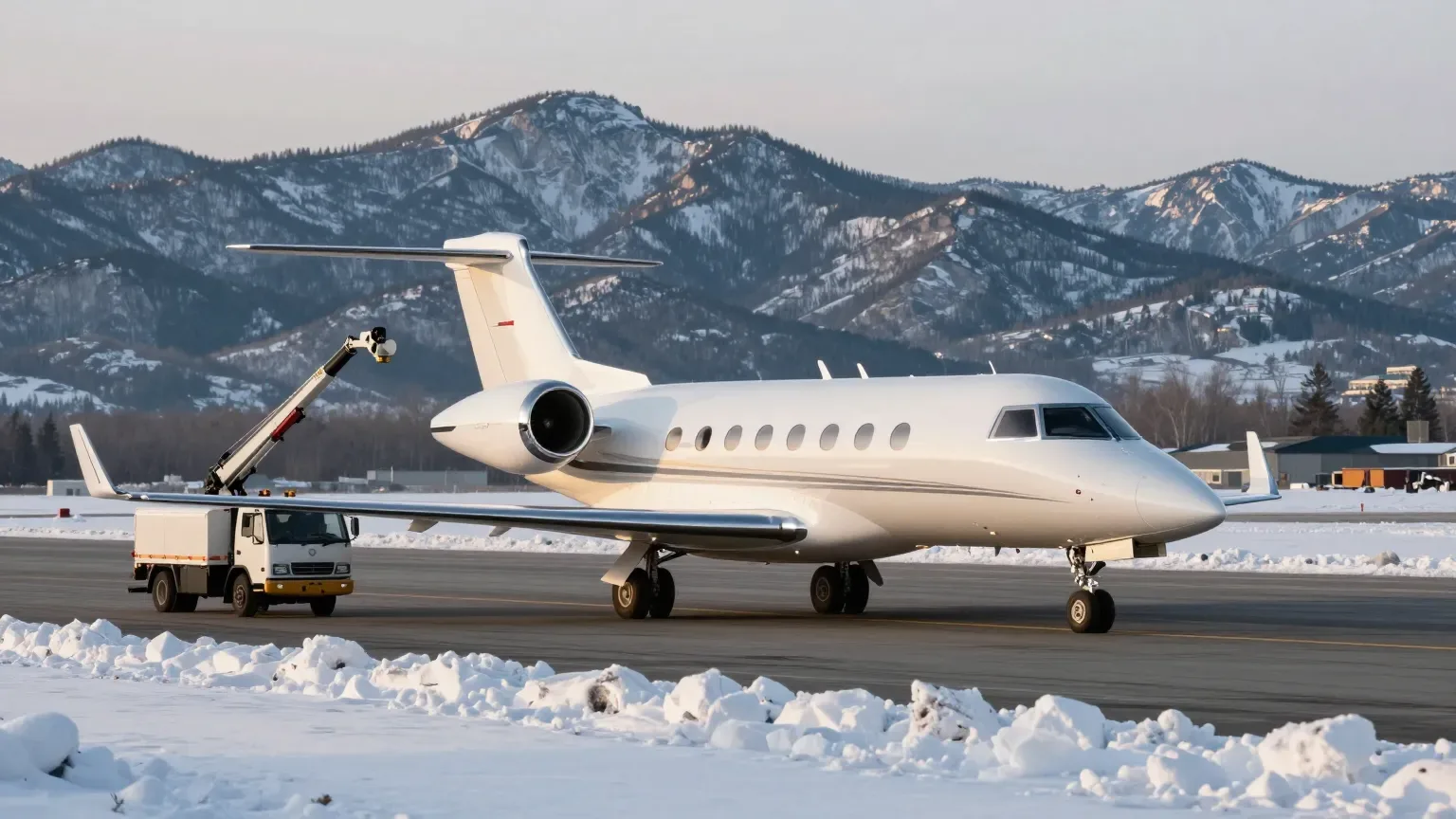
Frozen contamination on a wing, even a rough frost you could scrape off with a credit card, changes how the wing makes lift. So the rule is clean aircraft, full stop. Ground crews spray a heated fluid to remove what is already there, then in continuing precipitation apply a thicker anti-icing fluid that protects the surface for a limited window. That window is called holdover time, and it varies with fluid type, temperature and what is falling out of the sky. It can be generous. It can also be short enough that a taxi queue eats the whole thing.
When holdover time expires before the aircraft is airborne, the crew does not guess. The aircraft goes back for another application and the clock restarts. That is the mechanism behind most of the winter departure slips we relay to clients, and it is why we quietly pad morning mountain departures. The money side of all this, including who pays for the second spray, we covered separately in our note on de-icing season charter fees.
What to ask: is the aircraft in the de-icing queue or waiting for a pad, and what is the current holdover window. Those two answers tell you more than any departure estimate.
Contaminated runways shrink the numbers
Once snow, slush or ice is measured on a runway, the airport reports a condition code for each third of the surface and crews feed that into a performance calculation. Braking gets worse, so required landing distance grows. Acceleration on a contaminated surface gets worse too, so the takeoff numbers move in the same unhelpful direction.
On a long runway at sea level, the penalty disappears into spare pavement and nobody notices. On a short mountain runway at altitude, with terrain on the departure end, the penalty is the whole conversation. The arithmetic has three usual outcomes, and none of them is a cancellation:
- The flight goes exactly as planned, because the numbers still close.
- The flight goes lighter. Less fuel, which may mean an en route stop, or a hard cap on bags and passengers.
- The flight goes somewhere else nearby and you drive the last stretch.
Option three is the one worth pre-agreeing in writing. A client who has already told us they would accept a valley airport and a ninety-minute ground transfer gets a decision in minutes. A client we have to wake up and consult gets a decision when they answer the phone.
Mountain airports run on their own rules
Winter exposes geography. Denver to Aspen is the clean example, a forty-minute hop that replaces a long and occasionally closed mountain drive, and the Denver to Aspen route page has the aircraft and timing detail. What it will also tell you is that this lane is shaped by a box canyon, a published night curfew and an approach that only works from one direction.
Stack winter on top of that and the usable window narrows further. Low visibility can close the approach outright, because there is no alternative geometry to try. Curfew turns a two-hour delay into a next-morning departure. Snow removal between arrivals compresses the schedule for everyone on the ramp. Saturdays in high season are the tightest, which is why the crews who fly these fields weekly are worth more to you than a slightly cheaper tail from somebody who has never seen the place in February.
The practical move is the unglamorous one: take the early slot. First departures of the day fly before the queues build, before the temperature swings, and with the whole day left as recovery room.
Who makes the call, and what that is worth
Here is the part we are firm about. The decision to go, wait, divert or stop belongs to the operating carrier and its pilot in command. We are a Part 295 broker. Every flight is operated by an FAA Part 135 certificate holder, and no amount of client pressure, schedule pain or revenue on the line moves that boundary. If an operator says the numbers do not close, the numbers do not close.
Which is exactly why the vetting matters more in winter than in June. The crew making a marginal mountain call under time pressure is the product you actually bought. Our pilot standards carry no weather carve-outs, deliberately: a twenty-minute repositioning leg in clear skies is crewed to the same experience and currency floor as a transatlantic night crossing, because minimums that flex with the forecast are not minimums. The wider written floor, including certification, audit standing and the annual re-audit cycle, sits on our safety standards page.
Book winter like you expect weather
None of this requires you to become an amateur meteorologist. It requires four decisions made before the forecast exists.
Tell us your latest useful arrival with its time zone, not your preferred departure time. A departure time is a wish. A latest useful arrival is a constraint we can actually plan backwards from, and it is the single most valuable sentence in a winter trip brief.
Pre-approve an alternate. Name the nearby airport and the ground transfer you would accept, in writing, when nobody is stressed.
Take the first slot of the day in and out of mountain fields, and keep the return flexible rather than tight against a Monday morning meeting.
Know the recovery plan before you need it. Our guide to delays, mechanical issues and replacement aircraft walks through the questions that separate an estimated departure from an approved plan, and the pre-booking safety checklist covers the operator, aircraft and crew questions to resolve while it is still October.
Winter flying is not riskier. It is just less forgiving of vague plans. Be specific, build in slack, and let the people with the performance charts do the arithmetic.
Questions this raises
Asked at the desk
Yes. Business jets are certified for flight in known icing and routinely operate through snow, low ceilings and wet runways. What stops a flight is usually a measured runway contamination limit, an expired de-icing holdover window or a crew duty limit, not the snow itself.
It is the protection window an anti-icing fluid provides after it is applied, and it varies with fluid type, temperature and the precipitation falling. If the window expires before the aircraft is airborne, the crew returns for another application and the clock restarts.
Contaminated runways lengthen the distance needed to stop and to accelerate, so the performance calculation can require less weight. That may mean fewer bags, an en route fuel stop, or departing from a nearby airport with more pavement.
The operating carrier and its pilot in command. JetNine is a Part 295 broker and every flight is operated by an FAA Part 135 certificate holder, so no client request or schedule pressure overrides that call.
Take the first departure slot of the day, give us your latest useful arrival with its time zone rather than a preferred departure time, and pre-approve an alternate airport and ground transfer in writing before anything goes wrong.
JetNine dispatch desk · Updated October 9, 2026 · safety · seasonal · weather · operators